- New in 2026 Photos
- Galleries
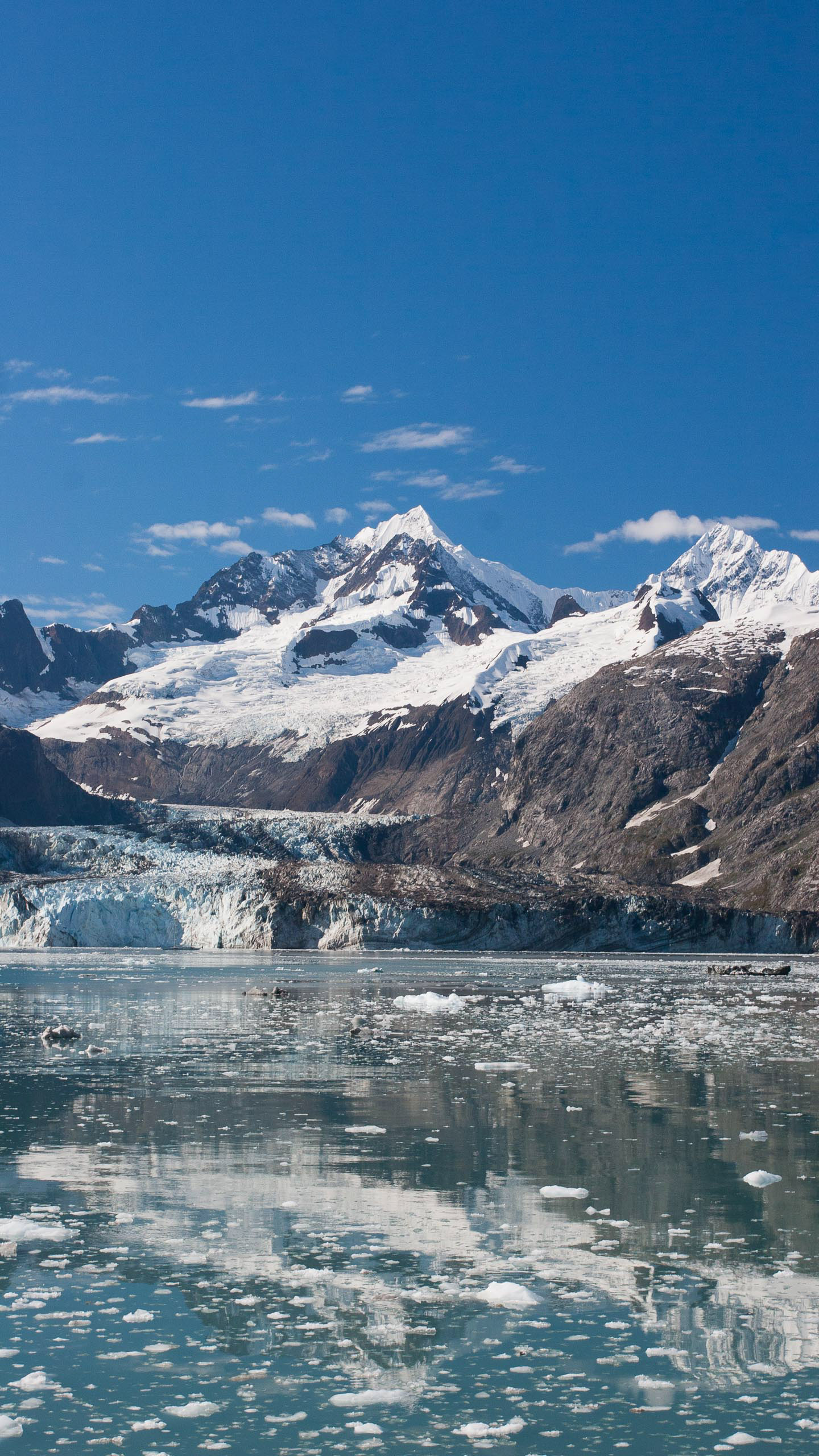
A classic Glacier Bay view unfolds at Johns Hopkins Inlet, where the fractured blue face of Johns Hopkins Glacier presses into the still, silty waters at the head of the fjord. Towering behind the ice are two prominent sentinels of the Fairweather Range: Mount Orville to the left, rising to 10,272 feet, and Mount Wilbur to the right at 10,305 feet, their sharp, snow-laden ridgelines catching the light above the glacier’s frozen flow. These peaks are part of one of the most rugged mountain systems in North America, sculpted by both tectonic forces and relentless glaciation.
The Fairweather Range owes its dramatic relief to the ongoing collision and lateral movement between the Pacific Plate and the North American Plate along the Fairweather–Queen Charlotte Fault system, a major transform boundary that runs just offshore. Over millions of years, immense compressional forces uplifted ancient marine sedimentary rocks and accreted terranes, thrusting them skyward and creating steep, unstable topography. Subsequent ice ages carved deeply into this rising landscape, with massive valley glaciers gouging out fjords like Johns Hopkins Inlet and sharpening the peaks into jagged arêtes and horns.
Today, the scene captures an active geological moment: mountains still being pushed upward, glaciers still flowing downslope, and the inlet itself slowly rebounding as the ice retreats. The juxtaposition of ice, stone, and sky in this view is a reminder that Glacier Bay is not a static wilderness, but a living record of plate tectonics, climate, and time written on a grand Alaskan scale. Photographer: Sean Neilson